Monday, 23 February 2015

Dun February

I always used to call it Februaryitis.  Everything is grey; the brown soil is grey, the green grass is grey, the sky of course is nothing but grey.  So depressing.  Winter has gone on too long already.  No doubt, climate change has ensured that things move faster and winter lasts less long - doesn't feel like it!

The sea of hay in the middle distance was once a crisp, tidy, plastic-protected cube of 330 bales.  The sheep crept under the plastic and ate the lower bales - the gales arrived - the plastic blew off.  After tying the plastic back down four times, we gave up, and the sheep have the pleasure of climbing all over their dinner.  It does at least save me the chore of barrowing two bales a day from the barn out to the hay rack. 
You can see the mud that 41 sheep and one shepherd have churned up.

The horses have done even better.  The camera has exaggerated - nonetheless, here is Hope at her pink bucket, her hay heap beyond.  She and Bob are so fed up with this.  They have been very good really, but the 8-weekly visit of the farrier to trim their hooves in the barn is getting more and more of a trial of strength as they "arm-wrestle" to get some attention and activity more exciting than their field (bare grey grass) and their feeding-lot (grey mud).
Hope will have to move on.  The farm isn't big enough for two full-size horses, and she will take more work to bring into full activity than we expected (this is me and her owner, Jane, my most useful friend!).  Bob will stay and, as a loving and willing but wholly untrained 3-year-old, take all the attention we can give him.

It hasn't been a bad winter, all in all, but as ever, I'll be glad when it's over.  The snowdrops are fresh and clear and sweet as ever.  The veg garden is in the middle of its biggest re-design for nearly 20 years - lots to get the teeth into!  Mine certainly - yours, I hope.  There's always hope.

Saturday, 4 October 2014

Bob Hope comes to Little Mill Farm

This is Hope.

She is a rescued brood mare, nine years old, sweet-natured but needing a lot of feeding up and a lot of human attention, which she's not used to.  She is broken to ride and drive, which is a good start!
                                                                        
And this is Bob.  He is off the mountain, a two-year-old colt who is to be broken the Horse-Whisperer way.  Already you can lean on his back and he doesn't even look to see what's happening.  He is absurdly friendly, but prefers carrots to apples.

He was named by us before we found Hope - who had her name already.
;
And here they are ignoring each other.  Bob had been here about five hours, Hope sulked and refused all attention except apple, but they will settle down together very well.  Hope's coat is now shining much more than when she arrived two weeks ago.  The grass is good down here.

Fortunately for me, my friend Jane, who helps with the sheep and the washing up, is very experienced with horses.  She gets to keep a couple of horses with free feed and housing, and I get to learn harness work.  I want them to pull beams to crush bracken; to pull a sledge or cart with firewood, muck, hay, straw, etc; and, maybe, turn the drying hay slowly and gently to preserve the precious herbal leaves.  All those jobs can be better done by horse-power than tractor-power, especially in a wet winter.

Next spring - the new geese pair take to the Road - Bing and Dorothy   . . . . .

Sunday, 27 July 2014

More hay pix


It's hot work - but it really is as idyllic as it looks.  And the satisfaction with a crop like that!  Wow.

Wednesday, 23 July 2014

It's that time of year again

Hay!
Wonderful stuff.
There are three fields to make this year, and it's a lovely thick crop after the mild wet winter and hot summer.  The sheep are a bit pinched for grazing in this heat, but I have to look ahead to the winter too.

This year, as last, Nick from Monmouth is making it for me.  He did time at an agricultural college, worked on a farm for years, still misses it.  Even so, I have to pay him!  So half the crop of bales will be stacked in one of the fields, under a tarpaulin, until I can find buyers for it.  I can advertise it as "lighter bales very suitable for ladies" - because that's how I need them to be.

After my "winter horribilis" I still haven't got round to buying in any pigs, and the veg garden is sparsely planted this summer, but I have had a brilliant idea - of moving most of the veg growing back down behind the house (the proper permaculture place for it) where it's more easily available for short spells of work or picking.  The poplar windbreak has got so overgrown that the air behind the house there is often stagnant and laden with spores in a hot summer, which is bad for veg.  One, I will have the poplars severely cut back (thereby providing myself with large quantities of firewood and wood chips for mulch), and two, I will just have to live with that!  This means, too, that I can alternate veg and hens out there, utilizing the hens' fertility - a very good thing.

In this pic you can just about see the faces of two house martins peering out of the nest, awaiting the arrival of the parents with beakfuls of insects.  They are nearly ready to fly.  I am thrilled about this, because they're the first house martins to have fledged in all my 26 summers here.  Twice, a pair has tried, and each time the magpies waited till the eggs hatched and then struck.  This year it was the magpies who got struck; by the jackdaws.  I cheered, I'm afraid (anthropomorphism at work.  But if I provide a lovely soffit for house martins, I don't see why I shouldn't have the result  . . . . .  ).

Thursday, 5 June 2014

Where next?

If you have read earlier posts, you will have seen that my mother died last October in her cottage on the farm, after living here for 18 years, and contributing far more than her age - 80s, 90s - might warrant.

A month ago my husband died in his nursing home. We had bought the farm together in 1989, after 10 years of partnership, and ran it together for 14 years as the first registered organic farm in Gwent.  Michael suffered a series of strokes from high blood pressure after the Foot and Mouth outbreak of 2001, lost more and more of his mental capacity, and finally retired to a nursing home in 2009.  I have been effectively running the farm's 30 acres (11 hectares) single-handed since 2004, and expected to be able to go on doing more of the same now as a single woman, but I find that - at any rate to begin with! - it's quite different.

I am struggling with the responsibility and all the work involved.  No doubt many wwoofers will be a little put off by this.  But, if you aren't, I need strong arms and minds more than ever before!  I believe I am as sociable and talkative as before - but am finding it difficult to cope with the immense business of keeping the place on its feet.  If anyone feels like being a lifebelt - do, please, get in touch!


Thursday, 27 February 2014

. . . . . And so spring springs, as ever

There's something about lambs  .....

No.2 ewe, on the left here, gave me some sleepless nights.  For weeks she was globular, with an udder like a football.  But she had just the one lamb, this morning, large and fit, and both are healthy.


This not-so-little mite was no.1, born three days ago, and is getting deeply curious about his human carers already.


And here are the first twins.  Their spotty knees are the genetic inheritance from their mum; her breed is mostly Ryeland, a medieval breed based locally, between Hereford, Ross on Wye and Monmouth, and developed to make the most of the local red soil which lacks some minerals.  We've always found they do well here; should I go back to that breed after my trial of primitive Hebridean sheep?  My major problem with the Hebs is their colour - black - impossible to find under a hedge on a dark night.  I hadn't thought of that.

But don't forget the veg garden! It's still claggy and water-bound, but now is time to start sowing - broad beans in the tunnel, and tomatoes, celeriac, chillis, and more in the greenhouse.  The ground would be warming now if it weren't so wet.

Saturday, 8 February 2014

Wet

"Wet" doesn't do it justice  . . . . .  In the past 8 weeks the farm has had 500mm (20 inches, in old money) of rain.  To put ir into context, the hot dry year of 2003 gave us a total of 636mm in the whole 12 months. Most years we get around 900mm.

Not much can be done in these conditions!  The higher end of the farm is just very wet - but the bottom is completely sodden from the rain rushing off the lane and through the fields on its way to the stream.  The veg garden is in the middle.  There will be more slugs than soil come spring.  Thank goodness there are no pigs on site right now.

 
Wet sheep.  I've moved them uphill now; their new field will soon be a bog too.


Wet hens.  They spend the day sheltering by the back door.  No wind or rain there, but lots of mess for me to step through.


I'm still hibernating.  Roll on spring!  And the fun of tackling those slugs!  Wwoofers, you will be so welcome!


Sunday, 22 December 2013

And So ... ... ...


What a long year.  Achievements seem in short supply.

It was a lovely autumn; much drier than usual; the leaves hung on the oaks till mid-December, and the ones that did fall were heaped in toasty piles round the trees and hedges.  Until last week, that is, when the rain started again  ...  oh lor'.  The sheep stand round with their heads down, waiting for it to stop; the hens cluster round the back door, tapping on the glass to be let in; the cats leave a line of muddy paw prints along the edges of my bed, before jumping up and drying themselves on me and my night-clothes.

Next year's aims; yes, let's be positive! :

1.  More pigs again.

2.  Try to sell the first year's (2012 and 2013) half-bred Hebridean lambs.

3.  Find the right tenants for my mother's little cottage.  (May be there already with that one.)

4.  Of course, get the veg garden in spick-and-span, top-class condition.  You wouldn't believe how hard that can actually be!

Happy Solstice / Yule / Christmas-if-you-must to you all!

Thursday, 31 October 2013

The End of an Era


No doubt many wwoofers remember my mother, happily digging and weeding in the vegetable garden into her 93rd year.  She loved working in the sun, and sitting in the sun.  Between 2005 and 2009, when all my time and energy went into being sole 24-hour carer for my husband, she alone kept the veg garden alive; it's only thanks to her efforts that I have somewhere moderately clear to grow food today.  She was 85-89 during that time.

Over the last summer her health declined and she died in October of heart failure.  She was 93 and a half - she was always proud of reaching the half-way point to the next milestone.

Sustainability shouldn't end there.  The family wanted, as she would have wanted, the most green and natural burial possible.  With the support of a Natural Burial Ground near Monmouth, we buried her shrouded in her beloved cellular blankets (pure wool) with no coffin, straight into the grave in a dedicated and very beautiful field.


  She is lying in her pink blankets, by the grave.


And is being lowered into the ground by her son-in-law, grandsons, and eldest nephew.


And is settled gently into the comfort of her last resting place.


We'd all recommend this as a moving and very personal way to say goodbye.

Now back to work on the farm and garden and orchard  . . . . .  I may have laid hands on a pair of horses at last.  They are so tiny that I could almost pick the smallest one up in my arms.

Wednesday, 16 October 2013

A tough time . . . . comes to all hosts


 A better summer than last year, but the ill health that even wwoof hosts can't always avoid has slowed things up far too much.  As ever, wwoofers have been wonderful; reliable and hard-working and cheering.  Thank you all!

There have been other set-backs.  Our excellent local abattoir has ceased killing anything but cattle, so I have, at present, nowhere reliable to take my lambs from which I can be sure I will get my own back.  That's worrying.

Lack of energy has led to severe paperwork back-logs.  It's difficult to set to with a bit of paper at the best of times.

But the new hens have been very supportive; they chatter underfoot in the kitchen, and when no scraps are forthcoming, they settle down under the kitchen table and doze off until life gets more interesting again.


Four horses from the local rescue centre have been recuperating on my super grass.  I am angling to get my draught-horse from there; need to wait till a suitable one turns up; maybe little Storm and Cane (Kane?) on the left here.  They're small enough to be manageable by a complete novice like me!


And I now have super new compost bins (wwoofer-built), the original ones having fallen to bits.  Here's the late-summer's harvest of fertility.  There are two more bins to come, for the autumn and early spring collections.  My light steep soil needs constant boosting so I'm confident that this time, next year really will be better.


Friday, 19 July 2013

Phhhheeeww  . . . . .

Hot, or what? Too much for me. Amazingly, I had two wwoofers here who didn't mind the heat (they are from South America) and they spent days clearing the shoulder-high weeds that had grown a metre in three weeks. (Why won't the veg grow as well?) Wet followed by warmth is a good recipe for weeds. Nicolas and Nadia, I salute you!

The jackdaw overstayed his welcome, but in the end I taught him to pick up his own food, instead having it thrust down his throat. It took a while for the cats to accept him in the house without growling, but they did - here are me, my huge cat Fish, and Jack, having a cuddle together.
 The hay fields looked glorious before the cut. We haven't had July haymaking weather like this since 2006.


The hayfields are of course composed of plants that grow just as readily in the garden, where they are not supposed to be - and are therefore classed as weeds. No problem howking them out from the veg beds as the surrounding fields are full of them and will readily replace them.


You can see how beautifully green the bales are.  Good hay at last! The beauty of my meadows is that they are full of different flowers and grasses, giving the animals a varied and nourishing diet (unlike non-stop rye grass) and they are self-sustaining. The only thing I put on them to help them grow is sheep. They self-seed, the vetches and clovers provide all the nitrogen needed, and year by year they change with the weather and the grazing pattern. The helpers that I have to get in to do the carting (not being strong enough myself) are telling the whole town that my hay is the best they have ever seen.

Friday, 7 June 2013

Sunshine at last!


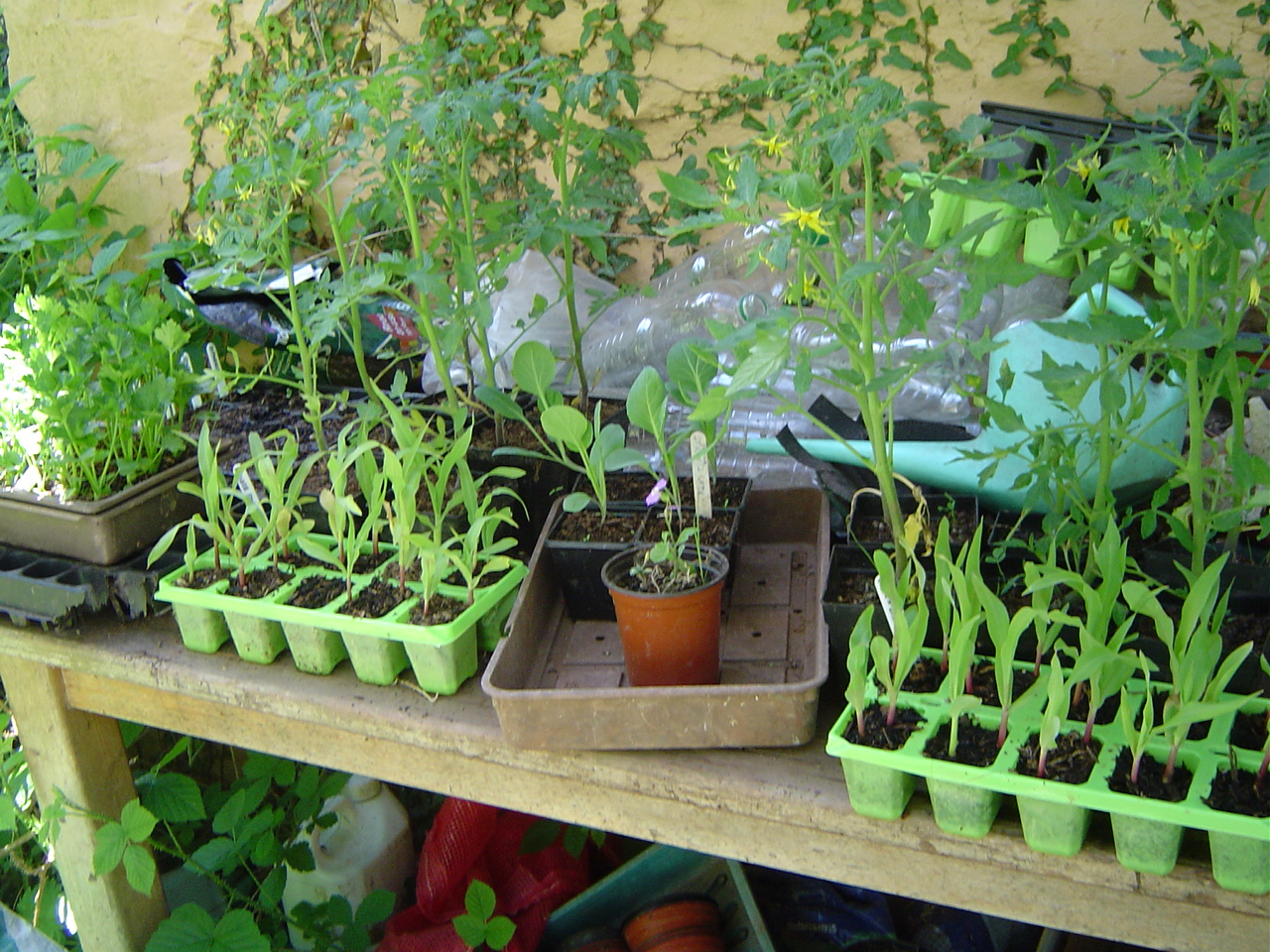
Pictures from the top! Two of the orchard - one of a brilliant flush of bloom after last year's disaster (one apple from 13 half-standard trees) and one of the two rams and 8 ram lambs from 2012 eating down the dock leaves, and doing pretty well.  Next shot down - plantlets hardening off on the sheltered table outside the back door before being planted out in open ground - celeriac, sweet corn, tomatoes, brassicas.  Next - my lovely front lawn, now a speedwell lawn, looking wonderful after years of hard work doing nothing.  And then the veg garden, also after hard work doing nothing, but at least a few veg are now growing there in the Anglo-Saxon primitive patches of clearing amongst the weeds.  So much better than last year.  There will be home-grown food next winter.  Finally, Jack-2013 - he fell down to the hearth from the chimney nest on Monday night / Tuesday morning, quite a well-grown bird, still with me (Friday evening) and in-waiting for when he will be ready to be taken back by his parents to spend the rest of whatever life he has left as a proper wild family jackdaw.  He is sitting on my shoulder as I type this.  This happens regularly; I know the routine now; when he can fly he will be put in the front yard in a cage, for his parents to find, and when I think they are on the ball I will let him go, to be taken up and taken care of by the family unit.  "He" is purely courtesy, I have no idea of its sex!

The quantity of green spring growth has taken me utterly by surprise, as always.  I have started to get local workers to strim and mow the excess greenery.  The best Genetic Modification, I often think, would be to give humans two stomachs, so they could digest grass, of which the world has so much  . . . . .  I would be sitting pretty, with my multi-species, ancient grasslands, so much more interesting to eat than monoculture rye grass.  But it won't happen, and perhaps shouldn't.

Wednesday, 1 May 2013

The springboard hasn't sprung - yet

 This is a horribly grim grey scene for late April.  The natural world is still in hibernation - no leaves on any tree on the first of May (tomorrow)!  Doesn't excuse the farmer/smallholder/gardener from carrying on as though everything is bright and vigorous.  Here are a bunch of fencing volunteers (not wwoofers) deep in consultation about a straining post for the new pig paddocks.  Along with the hay meadows, the pigs will be a cornerstone of the locally-sustainable farm.  They will plough, fertilize, eat, feed other stock, and be eaten.  Or that's the plan  . . . . .
 Meanwhile work begins on replenishing the wood store.  Simon is sawing up big hazel branches cut from the lane hedges by last winter's hedge-layers; they're going to the back of the store, on the side that's to be started first of the new wood.  Hopefully, in late October rather than early September.  The stack on the left is what's left of last winter's wood; it will be in fine nick ready for cooler late-summer evenings.
The Esse wood-burning cooker I had delivered last July still isn't working properly.  A bit of hair-tearing going on.
Work finally starts on resuscitating the veg garden after summer of 2012's growing disaster - good work, Agric, thank you.  I sowed carrots three times and harvested a handful.  Even the weeds sulked and wouldn't come up to be composted.  I blame lack of light as much as surplus soil-water; it's a lovely day here so let's hope there's lots more to come!  (Could do with rain in between - just a little - to keep the soil crumbly and delicious.)  You can see the pig paddock fencing in the middle.  Handy for throwing veg over to piggies; not so good if they learn to climb it, or dig under the (double strand of) barbed wire.

 But at least the greenhouse is coming on this year.  This is (top to bottom, left to right) chillis: cardoons: tomatoes: celery: celeriac: tomatoes.  There are another 34 toms in pots, as well as the 3 dozen in the tray.  At the moment the forecast suggests a drought coming.  Well, as long as we have sunshine with it, I'm happy!

Tuesday, 2 April 2013

March 2013

 This month is all about sheep - and the weather.  Bitterly cold, some snow (not like January though), no grass, horrible (evidently) hay - but the lambs don't know any better, and anyway have Mum's milk to cheer them up.
I let each newest ewe-and-twins group free-range over the gardens to find something to nibble at.  The hens joined in - as hens will.


But towards the end of the month the sun began to appear, things warmed up, we all began to think maybe spring would start one day.

The sheep have eaten hardly any of that September hay this winter.  It's obviously tasteless and lacking real nourishment.  They have grazed and grazed the grass till it's barely more than roots and stubble, and apparently have done well on it!  I had no idea that sheep could get by on so little.  There's always something new to learn.  But now I don't know what to do with all that hay  . . . . .

Tuesday, 26 February 2013


In years gone by, February used to be the gloomiest month, hard to work through.  Last year, and the year before, the spring drought gave us bright and dry beginnings to the cycle of the year  . . . . .  Not this year.  It's all grey and dreary.  The brightest spot is the arrival of all those lovely new lambs!


 This is the first one.  And even with the lambs, there is a
major problem. They were supposed to be born from mid-
April (according to the date I put the ewes with the rams) - and their mid-February arrival tells me that the ewes have been impregnated by one of their 2012 sons, whose rubber band evidently didn't do the work I expected of it. So my beautiful and friendly (except when I have a feed bucket in my hand) Hebridean rams have had a dull and pointless winter. And instead of more 1/2-primitive sheep for next year, I have sheep that are still 3/4 Ryeland.

Well  . . . . .  next year I will do better; like check the ram lambs for untoward lumps at the end of July  . . . . .


The pig saga ended well though.  The picture here shows the sides of bacon and one of the hams salting on the draining boards in the pantry.  (I thought I wouldn't harrow you with pictures of the in-between stages). The blue bag in the sink is the bulk organic sea salt.  All the rest of the pigmeat is in the freezer. It seems a lot; but more than average is fat (good for cooking with, but it doesn't make a meal), and it is so delicious that it's hard to save enough of a joint for more than one day's cold dinner.

Little Mill Farm could support a large family, or even two or three smaller ones. (By support, I mean feed well year-round, and give most of the inhabitants a healthy productive open-air life.)  I'd like to think that's how it will end up, after my time here.  Meanwhile, I try to keep the options open for that next stage; and it's hard work for one person on her own. If you have ambitions to live like that, you could do worse than learn how, here!

Thursday, 31 January 2013

January 2013

This month's post was going to be about my first experience of having a pig killed on-farm, and having it cut up, and salting the bacon and ham, and making all the sausages.  Okay, one pig got done, for my co-Pig-Groupies, but THE SNOW came before the second (for me) could face her demise.  It has been one delay after another since November; much more work and expense than I anticipated, and moreover I'm not set up yet for full-time pig residence.


Piggy enjoyed rooting in the deep snow for snails.  She spent most of the time asleep in a deep-strawed loose-box; I did envy her.


I had some good snow-savvy wwoofers to help.  They found Piggy charming.  They didn't have to get her moved from straw to orchard and back twice a day!  -  though they did help a lot with the difficult first time into the dark, fusty, but well-provisioned loose box.  Her diet has been nearly all locally-grown barley and peas.  The local expert says that peas make for hard bacon.  We'll see.


The sheep are well-covered, don't mind weather, but were fed up at having to eat that dull late hay instead of being able to find small nibbles of grass.  The half-bred lambs, the start of my "primitive" flock to take me into a low-input, low-output future, are doing really well on rather meagre rations.  Now the snow has gone I have begun feeding them a little rolled oats, partly to make it clear that I am one of the good guys.


More snow pictures  . . . . .  it really did look gorgeous, until the animals and I began treading it down and churning it up with the underlying mud.  Getting around the fields got harder and harder.
The wwoofers and I were snowed in for several days; eventually they walked the 7 miles to Monmouth to get a lift to their next stay, while I finally got out five days later.
It's quite an art not to run out of anything, and there's always something that gets overlooked.  This time it was the biomass pellets, so the wwoofers had to use electric heaters in their bedroom.  It doesn't often happen, I promise!

Next month:  it really will be the saga of the pigmeat.